Album Of The Week: Talib Kweli – Prisoner of Conscious

CRAS Grad Chris Pummill is riding high on the coattails of a once in a lifetime opportunity. Finishing the CRAS program in 2011 with a 3.79 GPA and perfect attendance, Chris has lucked out with this latest peg in his recording career, coming by way of assistant engineering on Talib Kweli’s latest record.

TalibKweliSession936 225x300 Album Of The Week: Talib Kweli   Prisoner of Conscious

Released May 7th, the album hit #48 on the Billboard 200 chart and sold over 10,000 copies the first week it was out. This is a stellar follow up album from one half of the Black Star duo, and features guest appearances from a number of artists, including Nelly, Curren$y, Kendrick Lamar, Ryan Leslie and Busta Rhymes. Here is a little breakdown of Chris’ experience working on the record:

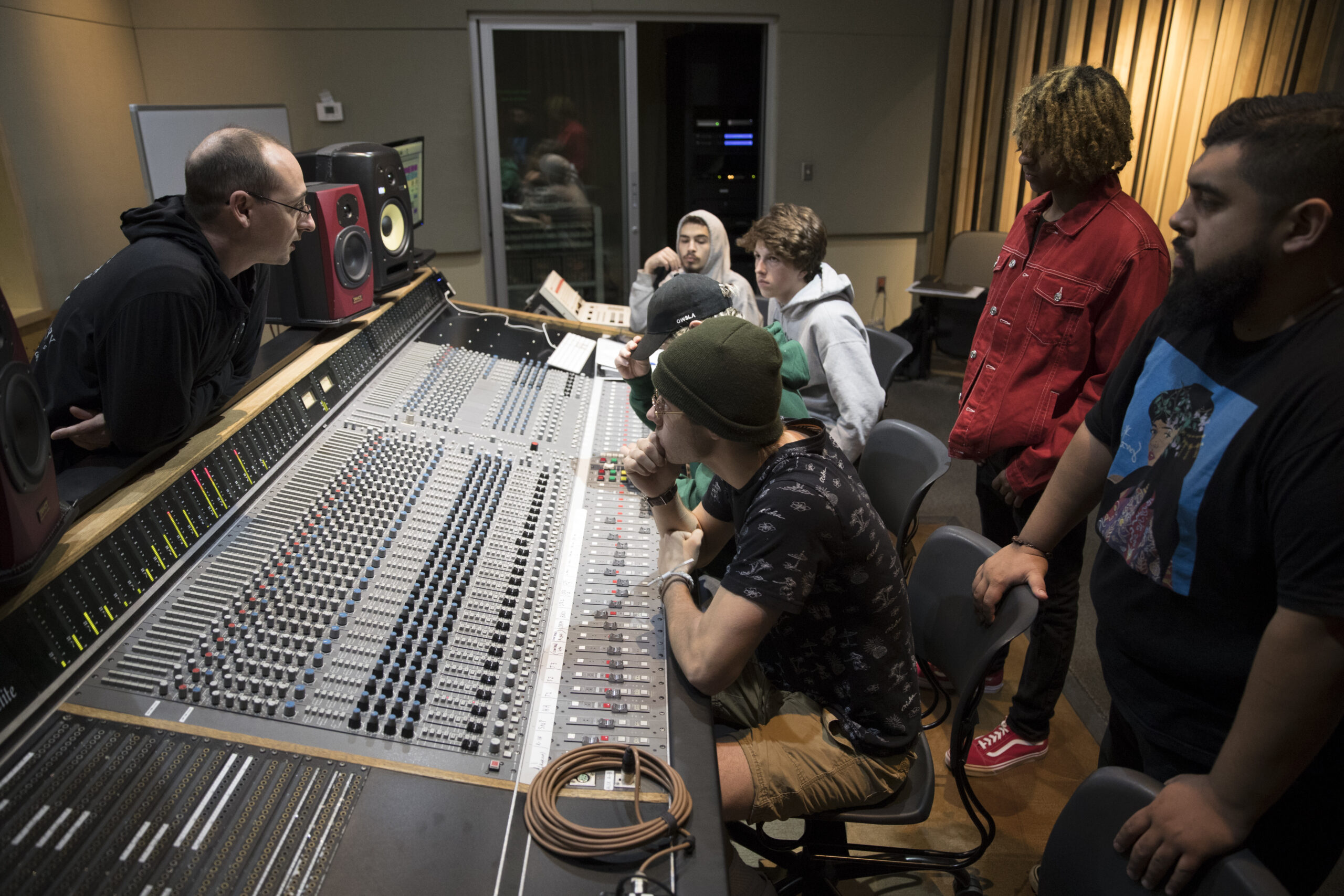
“I believe work on this album started in the fall of 2010 and when I got the chance to start working on it, it was my first day at Rough Magic Studios in April 2011. I had just interviewed and was slated to come in the following Monday when I got the call to come intern/assist at the last minute. After that 1st session, I ended up assisting on most of his sessions alongside Alby Cohen (engineer).

TalibKweliSession316 168x300 Album Of The Week: Talib Kweli   Prisoner of ConsciousOriginally, the setup was a Neumann U87 Ai (roll-off engaged) going through an Avalon VT-737sp. On the Avalon, we would do light compression (around 3:1) and very light EQ. Later we switched to the AKG 414B XLS (cardioid, 6dB pad, and 40Hz roll-off). Combined with the Avalon, the 414 did a good job of rounding out the highs that are synonymous with his voice. The U87 was great, but was a bit harsh and brittle at times. Recall of his usual settings and mic placement was very important as he was the type of artist that would just walk in and go! He would give Alby time to check the level and signal quality but more than a minute and you were just taking too much time.

There were a few sessions where I had to fill in for Alby either because he had Jury Duty or because he was sick. Right then I learned the importance of working quick, precise punches, following lyrics without a guide and NEVER RECORD OVER TAKES WITHOUT DUPLICATING THE TRACK FIRST! It was a serious “Baptism by Fire.”

TalibKweliSessionIMG0291 224x300 Album Of The Week: Talib Kweli   Prisoner of Conscious

Although there are a lot of great featured artists on the album, we only had 1 or 2 come through the studio. However, we did get to work with a slew of amazing session players. On songs like “Human Mic,” “Hamster Wheel,” and “Before He Walked,” we recorded with string players Chad Hammer and Gene Back. Due to the fact that it was just a cello and violin, we did layer after layer of the same parts and then added more layers of harmonies and little flourishes to make 2 guys sound like an entire string section. We direct mic’d the violin with a Nady RSM-4 ribbon mic (which sounded amazing despite its cheap pricetag), the cello with the EV RE-20 and used a U87 Ai over each of their heads to get a more ambient sound. The 87s ran through the Focusrite Red 8 mic pres and the direct mics ran through a couple of API 3124 pres.

TalibKweliSessionIMG02891 300x225 Album Of The Week: Talib Kweli   Prisoner of Conscious

On “High Life,” we ended up replacing the bass and guitar parts in the original beat with live guitar and bass by John Cave and Brady Watt. The bass went direct through the Avalon 737 with 5:1 compression and light EQ, which was a very common setup for bass in most of our overdub sessions. Guitar went through John’s pedal board into an Orange Dual Terror head into a Marshall half-stack. On the cab, we used an SM57 off-axis through the Joe Meek VC6Q for a gritty sound, the 414B XLS (6dB pad) through the API 3124 for a bright tone, and a U87 Ai in Omni as a room mic going through a Vintech 473. We got an incredibly clean and balanced sound with this setup, which I have now adopted (minus the room mic). In most of these OD sessions, Talib was not on hand to direct the players and trusted Alby to essentially produce the parts along with the players.

TalibKweliSessionIMG0294 300x225 Album Of The Week: Talib Kweli   Prisoner of Conscious

For most of the songs with features, Alby would have to import session data from outside sessions and marry our sessions with theirs. However, that wasn’t always the case. On “Rocketships,” we only had an mp3 bounce (vocals and instrumental) of the Busta Rhymes verse that we had to fly in, meld, and balance with our instrumental track. Mind you, this was a song produced by RZA and therefore was pretty much impossible to get on the grid. The final version of the song turned out great, but it was a nightmare to manage between studios and producers.

TalibKweliSessionKwe session 300x256 Album Of The Week: Talib Kweli   Prisoner of Conscious

It was an incredible experience to work with someone that I’ve listened to and been a fan of for years. I learned a LOT and get to have my name next to some hip-hop greats.”

Sometimes in the music industry, it takes years to get a chance like this, and it was incredible to see Chris literally get dropped right into the lap of greatness, working on an amazing session right out of school. Congratulations Chris!

Recording Magazine Spotlight on CRAS

CRASGilbert 300x200 Recording Magazine Spotlight on CRAS

Recently, chief editor of Recording Magazine Lorenz Rychner came out and visited the Conservatory. CRAS has had a relationship with Recording Magazine for a while, but this was the first time that Lorenz was actually able to come to see the campus in person. Recording Magazine is a phenomenal publication that covers all the ins and outs of recording, from techniques to gear, interviews and much more. We are proud to say that we offer complimentary issues of Recording Magazine to all of our current students, and the entire box of magazines that we got this last week have already flown off the shelves!

Lorenz got the full treatment of what we offer between both the Tempe and the Gilbert campuses, and he seemed to be quite pleased with what he saw! Here is a little clip of what he had to say in this current month’s publication:

“But beyond just that need for speedy mastering of one particular piece of production software, where do you go to learn the entire kit and kaboodle of audio production, not just for records, but audio for all kinds of end-uses, from games to television to movies to you-name-it, including the business end of it?

If you’re new to audio production, learning it all on your own, while not entirely impossible, won’t be quick or productive at first/ If you don’t have the time to wait around for it to happen, and you are serious enough to invest in your audio future, then a school can make it happen for you.

As one who used to teach in just such a school before taking on this magazine gig, I was delighted to visit CRAS in the Phoenix, Arizona area, a school that takes its stated mission seriously. The school has been around for just about as long as this magazine has been published, and it now operates out of two separate but interlinked campuses. Their curriculum impressed me mightily – 30 weeks of classes, structured in a ten-tier system of three weeks per “cycle”, with 24/7 access to the facilities outside class time. That’s a lot of opportunities to put into practice what the class time offered!

But here’s the kicker: Each student gets placed in a 12-week internship after school ends, with real-life companies and studios and organizations, selected according to the student’s personal aptitudes for the best match. Recording labels and commercial studios may be dwindling, but audio is not, so it’s good to see that youngsters are being prepared for the present and future in segments of the industry where their skills will be needed.”

Check out more of Recording Magazine and Lorenz’s works at their website here.


Grad Spotlight: Sorrel Brigman


SorrelBrigman Grad Spotlight: Sorrel Brigman

Graduating from the Conservatory in 2009 with a 4.0 GPA and perfect attendance, Sorrel Brigman has gone on to do great things! After leaving CRAS, she moved out to Nashville, TN, and did a ton of internship work, including working at the famous Blackbird Studios. She got to work along side all sorts of incredible talent, including Steve Marcantonio, who has credits working with artists from Jewel to Vince Gill, Taylor Swift to Carrie Underwood and so many more.

SorrelSteveMarcantonio 255x300 Grad Spotlight: Sorrel Brigman

Recently, Sorrel made it in the cover story piece for Mix Magazine this month. She has been working at RCA Studio A, also known as Ben’s Studio. Ben of Ben Folds Five now owns the place and has put it to good use. The studio has quite a bit of history, originally being known as RCA Victor Nashville Sound Studios. Built by Chet Atkins, the facility had a ton of major names swing through over the years. Elvis Presley, Willie Nelson, Roy Orbison, and even Dolly Parton, who recorded “Jolene” there.

SorrelBrigmanMixBenFolds Grad Spotlight: Sorrel Brigman


In 2011, they upgraded the studio console to a classic API 3232. When Ben Folds first moved into the studio, he primarily used it on his own, but in the past 5 years they have been bringing in other clients – Kellie Pickler, Willie Nelson, Faith Hill, Carrie Underwood and Alejandro Sans.

I caught up with Sorrel a little bit, and this is what she had to say:

“I’ve been at Ben’s Studio for three years this month. I started as an intern but have been an assistant here for almost 2.5 years. In addition to assistant engineering, I’ve lately also been doing some assistant managing for the studio as well. The room is amazing and the studio manager, Sharon Corbitt-House, brings in some amazing clients. I have had the privilege of working with Ben Folds Five (naturally), Alan Parsons, Kelly Pickler, Willie Nelson, Jerrod Neimann and Elizabeth Cook, just to name a few. It has been quite an amazing ride.

Some of my common intern tasks at both my internships (Ben’s and Blackbird) included session setup and tear down, being a runner (to go get supplies for the studio and meals for clients and staff) and lots of cleaning. It’s not to say that my supervisors were behind me forcing me to clean stuff, but taking care of the studio is a labor of love.

And there are plenty of uncommon tasks as an intern. At my first internship, the owner of the studio loved Dr. Pepper and the ice from Sonic (I mean, who doesn’t, really?) We had a Sonic ice maker at the studio, but the owner did not have one at his house. It was not entirely unusual to take two cups full of Sonic Ice and a cold 6-pack of DP to the owner’s house at night, leave them outside the gate. Only certain interns were trusted with this task because the owner was insistent that the buzzer not be buzzed (and thus disturb his family that was sleeping). I did that run a few times.

Another time as an assistant, I was covering for an assistant friend at a different studio. After the session as we (the intern and I) were tearing down, the client used the bathroom. He flushed the urinal and walked off. We walked by the lobby and heard a gushing sound. The urinal was stuck in flush mode and water was pouring out everywhere. We managed to get the water to stop, but clean up was a challenge. The intern was new and didn’t know where things were stored. I didn’t normally work there, so I didn’t know where things were stored either. The only mop we could find was rusted together (yes, rusted). We ended up cleaning up a small lake of pee water with paper towels and no gloves. It happens.

I have gotten a few album credits. That’s pretty exciting. You can check out my allmusic pages (one under Sorrel LaVigne, one under Sorrel Brigman).”

Sorrel LaVigne’s Credits at AllMusic.com

Sorrel Brigman’s Credits at AllMusic.com

Congratulations on doing an amazing job! I remember having you as a student and I knew you were destined for great things!


Beware the Sound of Fear

“It’s not a horror movie. It is a Santini movie.”

Released in Europe last year at the Edinburgh Film Festival, Berberian Sound Studio is a thriller movie focusing on the work of a sound engineer. Specifically, this unique film focuses on the job of a foley artist in the 1970s, trying to make authentic and stand-out sound effects for a horror production that he has been hired to work on.

It provides a great view into how sound effects are created and added to a film. It’s incredible to think of the imagination required and the creativity that it takes to figure out exactly what some sounds should actually sound like. How do you know what a bone snapping should sound like? What does it sound like when someone is getting viciously stabbed? This is the job of a foley artist, and we do have a series of classes dedicated to this art form.

During the 7th cycle of the CRAS MRPII program, three days of the week are dedicated to doing sound for film and post production. In recent years we have replaced the audio for parts of Pirates of the Caribbean, and this year we have been doing the audio for Avatar. Students get to learn how to use timecode, route signal through the board and record to tape, as well as Pro Tools, and have everything synchronized together. One of the unique mic techniques that students will use is the Decca Tree configuration, which is one of the more common spaced-pair mic setups. Part of these classes also include doing a scoring session with an orchestra to replace some of the theme songs of the films. Check out our photo shoot from one of the scoring sessions.

Even in today’s world of special effects, computers, sound libraries and DAWs, a lot of the time we will still make sounds from scratch. Whether it’s walking across a wood pallet to recreate the footsteps of a pirate walking a pier, or plunging a knife into a head of lettuce to get the juicy sound of someone being murdered.

Later on in the Conservatory program, we offer commercial production classes, where students do voice-over and sound replacement work for television commercials, movie trailers and radio advertisements.

This film has won numerous awards overseas, including Best Achievement in Production and Best Technical Achievement for Sound. It does seem hard to track down a good copy of this movie that will work in a conventional North American DVD player, but there are some copies of the original European Blu-Ray release on Amazon, and it does appear that NetFlix has intentions on stocking it sometime this year, although no date has been confirmed yet.

But, to hold you over, here is a trailer for the film. It’s awesome to see the vibe and presence of the history of film post production, including all the vintage audio gear, the sound booths, and the creation process!

HARMAN Lexicon Outboard Gear

Lexicon Logo HARMAN Lexicon Outboard Gear

The Conservatory is one of the few schools that has a massive focus on analog sound gear. 6 of our 8 full studios incorporate analog consoles from Neotek, API and SSL, as well as 24-track analog tape recorders from Otari and Studer. While this provides a lot of on-board signal processing capabilities, you can’t forget our outboard gear racks.

PatchBay 300x202 HARMAN Lexicon Outboard Gear

Connectable via bantam jack or TT patch bays, each studio has an array of outboard gear, and most notably we have a large collection of HARMAN Lexicon processors. We have four Lexicon MX400 units, two PCM92 processors, and some classic PCM80 and PCM70s.

ControlRoom 300x222 HARMAN Lexicon Outboard Gear

Before students get too immersed in the digital recording realm, they get hands on experience working with these units. Our curriculum fully revolves around understanding the way the audio signal chain flows, from the mic, through cables and eventually out to the speakers. By getting this fundamental signal flow knowledge in class, and being able to practice it hands on outside of class, students can build an incredible knowledge base that works great for studio recording, live sound and so much more!

mx400 300x83 HARMAN Lexicon Outboard Gear

The MX400 is a four input, four output reverb and effects processor. It has a powerful processor hiding behind and very intuitive and user friendly interface that allows for maximum efficiency with the least amount of time wasted.

pcm92 300x83 HARMAN Lexicon Outboard Gear

The PCM92 is a sleek, single rack unit that has Lexicon’s Room algorithm, which can create pristine and realistic aural “spaces”, whether they are halls, rooms, stages or infinite space. Coming with 1200 factory presets, and up to 96kHz sample rate, this is an amazing unit.

SFX LexiconPCM 80 Med 1 300x180 HARMAN Lexicon Outboard Gear

The PCM80 is a reverb and delay unit that has been a mainstay in both the studio and live sound venues. Nearly every concert that I go to, I see at least one of these in the gear rack. Simple, quick and easy to use, this is a great piece of technology to learn on!

“Our students get exposed to Lexicon early on,” said Tony Nunes, audio recording and production instructor at CRAS. “They start by learning basic chops and how to integrate outboard gear into the total recording setup. Our focus is very much hands-on, and we want students to be familiar with Lexicon as it’s what they’ll be running into in professional record production studios.”

Lexicon has even been nice enough to write up a testimonial on our school, and how our partnership brings about great opportunities for students and instructors alike!

Moby: Go

Born in 1965, Moby didn’t really start getting popular in the music scene until the late 90s. His fifth studio album, Play, sold 6000 copies on it’s first week out in 1999. But the song that really broke ground for him was “Go”, which was originally released in 1991, just as the rave scenes were starting up in America.

The song, which took elements from David Lynch’s Twin Peaks and almost got Moby sued, was hit first real breakthrough into the music scene. If you have some time to kill, check out this awesome documentary on his early steps into music production. This is a great video to watch if you are interested in getting into making your own music, or the audio industry altogether.

CRAS Student Selected for the Sennheiser Mentor Program

sennheiser logo 0 300x60 CRAS Student Selected for the Sennheiser Mentor Program

Congratulations to CRAS student Brad Bacon for being selected for the Sennheiser Mentor Program. Sennheiser will fly Brad to Charlotte, NC where he’ll spend the weekend observing the audio production process involved in broadcasting NASCAR’s Coca Cola 600. Brad will be shadowing Fox Sports Sr. Audio Mixer Fred Aldous, who just won his 20th Sports Emmy award. Fred, who happens to live in the Phoenix area where CRAS is located, dropped by the school and was able to meet Brad before his trip. He spent time going over the track and production compound layouts to give Brad some sense of what he’ll see during his trip later this May.

BradBacon 300x225 CRAS Student Selected for the Sennheiser Mentor Program

This marks the second student from CRAS to be accepted into the mentorship program. Last year Shawn Brewer was also selected to shadow Fred.

“He asked if things ever go wrong, and I said, no, nothing that you can’t handle as long as you’ve done all of your prep work correctly and anticipated where problems can arise,” Fred says. “He understands that broadcast is a situation where you get one chance to get it right the first time, and he appreciated that.”

Aldous, an Emmy Award winner for his mixing work, toured Brewer through Game Creek’s four-truck compound, including the FX A unit, the main production truck where Aldous operated from a Calrec Alpha with Bluefin; FX D and its Calrec Sigma used for the track-effects submix; and FX D, where a Yamaha M7CL console handled audio for the wireless in-car and other race comms.


In The Studio with Dub FX

Street performer and insanely talented vocalist Dub FX hails from Australia. He makes intricate and beautiful music using usually just his mouth, a mic, and some pedals for looping and effects. Making a name for himself, he has used word of mouth and social media alone to become successful over the last 5 years. Between just two of his live music videos, he has over 20 million views on YouTube and is still not signed to a label.

Here is a cool interview with Dub FX, showing you the inner workings of his studio and workflow. He primarily uses a Manley Vox Box,  a Rode K2 mic, a Moog Minitaur, an SPL Tube Vitalizer, and his new SPL Neos summing board.

Shure Sure Loves the Conservatory!

Recently CRAS hosted Shure’s wireless mic seminar in our huge 6,000 square foot live sound room. Shure microphones are a mainstay of the audio industry, and it’s no surprised we have quite a large collection of Shure mics, from SM57s and 58s to KSM32s and SM7Bs.

Peter Bish Adolfo Kirt Keith Morris 300x199 Shure Sure Loves the Conservatory!

Pictured: Instructor Pete Bish, Adolfo Acevedo, Administrator Kirt Hamm, Instructor Keith Morris

As a thank you gift, Shure representative Adolfo Acevedo presented us with some incredible new gear! We now have our hands on the KSM313 dual-voice microphone, as well as the SRH 840 and 940 headphones.

KSM313 137x300 Shure Sure Loves the Conservatory!

The KSM313 is a dual-voice ribbon microphone. One side of the KSM313 provides a brighter character that shines on your vocals, while the other side offers a rich, full sound that’s ideal for your amplified instruments. The ribbon in this mic is made out of Roswellite material, which is capable of withstanding up to 146dB SPL! The list price on this mic is $1295, and while it appears to be out of stock at SweetWater.com, you should be able to find one soon.

The SRH840 and SRH940 are high quality, professional grade headphones that are incredibly comfortable and provide great performance. Thanks Shure!

Adolfo Kirt 300x199 Shure Sure Loves the Conservatory!

In-Browser Synthesizer!

Here is a cool page that Murat Ayfer developed that allows you to use your computer keyboard to play sounds out of a web browser. You can also go through and modify various aspects of the waveform, including timbre, time, frequency, duration, envelope and pitch bends. This is a neat and fairly intuitive way to get into understanding how synthesizers can be used, and how you can make your own sounds. There is also a visual display as to how the virtual “strings” would resonate as the sound is being generated. You can also look up presets that other users have made to help you get more of an idea of what is going on.

*Note – currently this page only works through Google Chrome or Safari web browsers. He is working on adding support for other browsers, such as Firefox.

Timbre, (the texture of sound; the thing that makes you distinguish between a guitar and a saxaphone) is our perception of the particular overtonic content of a sound.

This means that a single note you hear has several frequencies playing at once. The loudest frequency is referred to as the note you hear. For example, 110Hz is an A. The other, quieter multiples of the root are its overtones. 220Hz, 330Hz, etc. would be overtones of A.

Tonehack lets you pick these frequencies yourself, and using your cursor, draw how these frequencies change over time.

tonehack.com